
Across Canada’s plastics manufacturing sector, labour shortages continue to challenge growth, productivity, and long-term competitiveness. At the same time, manufacturers are under pressure to improve efficiency, reduce waste, and modernize operations.
Automation is often framed as a solution to these pressures—but increasingly, leading manufacturers are discovering a more nuanced reality: automation is not simply about reducing labour. It’s about redeploying and upskilling it.
The Shift: From Labour Reduction to Labour Evolution
For many plastics processors, the initial driver behind automation is straightforward: reduce repetitive manual tasks, improve consistency, and control operating costs. But what follows is often more strategic.
“When companies start to automate, they quickly realize it’s not about eliminating people, it’s actually about freeing them up,” says Rob Miller, President of Wittmann Battenfeld Canada. “The real opportunity is to take employees out of repetitive, low-value tasks and move them into roles that improve the business whether that’s process optimization, quality control, or technical oversight.”
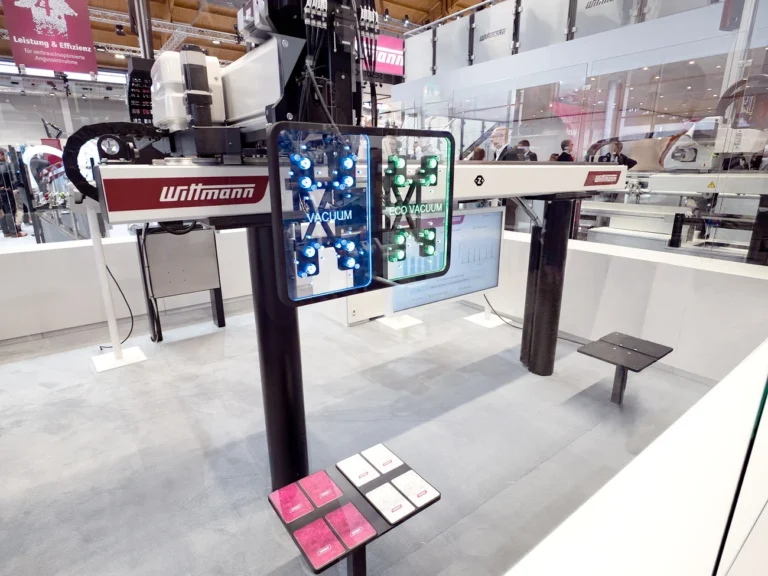
In injection moulding environments, this shift is particularly visible. Tasks such as part removal, material handling, drying, and conveying that were once heavily labour-dependent can now be automated with integrated systems. The result is not just fewer manual interventions, but more consistent production and better use of skilled labour.
Addressing Canada’s Skilled Labour Gap
Canada’s manufacturing sector has been grappling with a widening skills gap for years. According to industry groups such as Canadian Manufacturers & Exporters (CME), finding and retaining skilled workers remains one of the top constraints on growth.
“As outlined in our 2025 Manufacturing Workforce Report ‘Keep Calm and Keep Training’ manufacturers are dealing with a growing skills shortage driven by retirements, a shrinking pipeline of skilled trades, and the increasing complexity of modern production. Automation is helping address that challenge, not by replacing people, but by allowing companies to upskill their workforce and make better use of the talent they already have,” said Dennis Darby, President and CEO of CME.
Automation helps address this challenge in two ways:
- Reducing reliance on hard-to-fill roles
- Creating opportunities to upskill existing employees
Rather than competing in an increasingly tight labour market for entry-level or repetitive roles, manufacturers can invest in training their current workforce to manage more advanced systems. Again, not replacing human resources you’ve already invested time, training and money in but redeploying them in ways that benefit them and the company.
“We’re seeing more customers take a long-term view,” Miller notes. “They’re investing in automation, but at the same time, they’re investing in their people, training them to operate, maintain, and optimize these systems. That’s where the real value is.”
And this isn’t just coming from the people in the industry. That same perspective is shared by the people educating the next generation of manufacturing labour for the plastics industry. According to Neal Mohammed, the Director, Barrett Centre for Technology Innovation Humber Institute of Technology & Advanced Learning, it’s the logical approach:
“Automation isn’t just about cutting costs it’s about using those savings in smarter ways reallocating them more strategically. Companies can reinvest in their people by building new skills, improving capabilities, and strengthening their workforce. In the plastics industry, the real value of automation comes from supporting workers, not replacing them.”
Polytechnics Canada is a non-profit association representing 13 leading research-intensive, publicly supported polytechnics, colleges and institutes of technology. They agree that significant change and innovation is inevitable, but can be calibrated most efficiently with an eye on making sure it’s happening with open lines of communication and dialogue with the relevant educational and training institutions.
“The world of work is changing and this is something polytechnics are particularly adept at recognizing in their programming,” says Sarah Watts-Rynard, CEO at Polytechnics Canada. “I often suggest that manufacturing companies take the time to share insights into how their operations are changing with their training partners. This gives polytechnics an opportunity to adjust both full-time and continuing education programs to suit evolving industry needs.”
From Operator to Technician: A Practical Evolution
In many plants, the transition is already underway. Operators who once performed manual tasks such as part handling or material loading are being trained to:
- Monitor automated cells
- Manage robotic systems
- Oversee process consistency
- Analyze production data
This shift elevates roles from manual execution to technical oversight, creating more engaging and sustainable career paths.
Industry organizations like Canadian Polytechnics and regional training centres are increasingly aligned with this trend, offering programs focused on advanced manufacturing, automation, and mechatronics, skills that directly support modern plastics operations.
The ROI Conversation Is Changing
Traditionally, automation ROI has been calculated based on:
- Labour cost reduction
- Increased throughput
- Reduced scrap
While those metrics remain critical, manufacturers are now factoring in additional benefits:
- Improved employee retention
- Reduced training costs for repetitive roles
- Greater operational resilience
- Enhanced ability to scale production
“The ROI isn’t just about headcount,” says Miller. “It’s about building a more capable operation. When your team is more skilled and your processes are more consistent, the entire business becomes more competitive.”
Building a More Competitive Canadian Manufacturing Base
For Canadian plastics manufacturers, this approach has broader implications.
By combining automation with workforce development, companies can:
- Compete more effectively with lower-cost jurisdictions
- Improve product quality and consistency
- Respond more quickly to customer demands
- Create higher-value roles that attract and retain talent
This is particularly important in sectors such as automotive, medical, and packaging, where precision and reliability are critical.
A Balanced Path Forward
Automation is often positioned as a disruptive force, but in practice, it can be a stabilizing one.
When implemented strategically, it allows manufacturers to:
- Reduce dependency on volatile labour markets
- Strengthen internal capabilities
- Future-proof their operations
And importantly, it offers a way to align business performance with workforce development.
“As an industry, we need to move away from thinking about automation as replacing people,” Miller adds. “It’s really about enabling them to do more valuable work and helping companies build stronger, more sustainable operations as a result.”
Downloads
Insert media attach from post editor